7 Jabotinsky st. Moshe Aviv tower, 19th floor. Ramat-Gan

Paediatric mycosis fungoides – characteristics, management and outcomes with particular focus on the folliculotropic variant

  1. Reiter,1,2 I. Amitay-Laish,1,2 M. Oren-Shabtai,1 M. Feinmesser,2,3 D. Ben-Amitai,2,4,†
  2. Hodak1,2,*,†
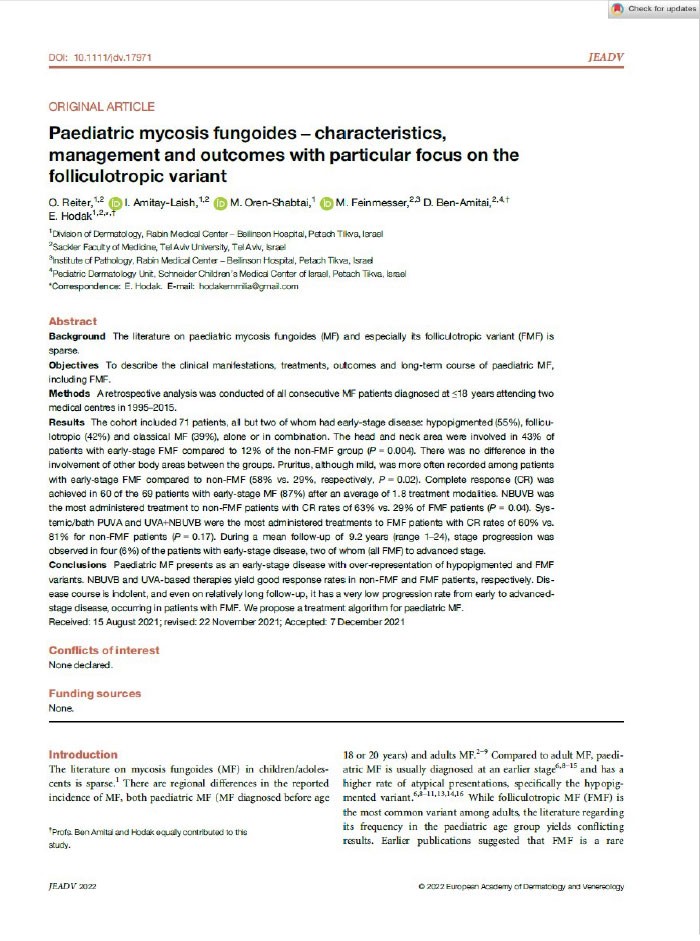
  Abstract Background The literature on paediatric mycosis fungoides (MF) and especially its folliculotropic variant (FMF) is sparse. Objectives To describe the clinical manifestations, treatments, outcomes and long-term course of paediatric MF, including FMF. Methods A retrospective analysis was conducted of all consecutive MF patients diagnosed at ≤18 years attending two medical centres in 1995–2015. Results The cohort included 71 patients, all but two of whom had early-stage disease: hypopigmented (55%), folliculotropic (42%) and classical MF (39%), alone or in combination. The head and neck area were involved in 43% of patients with early-stage FMF compared to 12% of the non-FMF group (P = 0.004). There was no difference in the involvement of other body areas between the groups. Pruritus, although mild, was more often recorded among patients with early-stage FMF compared to non-FMF (58% vs. 29%, respectively, P = 0.02). Complete response (CR) was achieved in 60 of the 69 patients with early-stage MF (87%) after an average of 1.8 treatment modalities. NBUVB was the most administered treatment to non-FMF patients with CR rates of 63% vs. 29% of FMF patients (P = 0.04). Systemic/bath PUVA and UVA+NBUVB were the most administered treatments to FMF patients with CR rates of 60% vs. 81% for non-FMF patients (P = 0.17). During a mean follow-up of 9.2 years (range 1–24), stage progression was observed in four (6%) of the patients with early-stage disease, two of whom (all FMF) to advanced stage. Conclusions Paediatric MF presents as an early-stage disease with over-representation of hypopigmented and FMF variants. NBUVB and UVA-based therapies yield good response rates in non-FMF and FMF patients, respectively. Disease course is indolent, and even on relatively long follow-up, it has a very low progression rate from early to advanced stage disease, occurring in patients with FMF. We propose a treatment algorithm for paediatric MF.
Share the Post:

Latest Researches

In need of treatment? guidance?

Give us a call or fill in your details and we will get back to you

Skip to content